

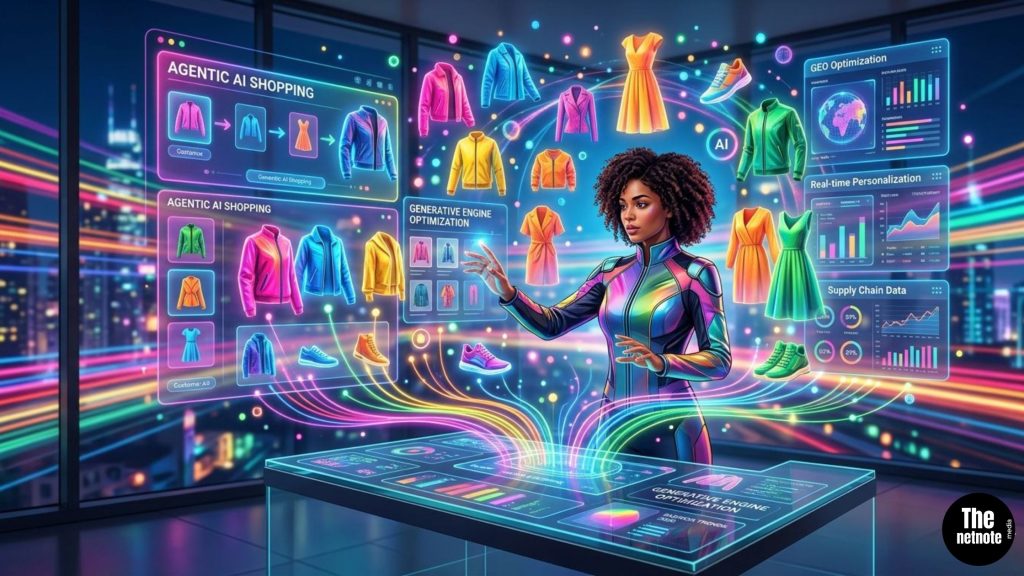
Looking at the digital marketing and apparel landscape in 2026, one reality is starkly clear: traditional Search Engine Optimisation (SEO) as we once knew it is rapidly facing obsolescence. The days of a consumer typing “best linen summer dresses” into a Google search bar, scrolling through pages of blue links, and manually browsing shopfronts are dwindling. Instead, consumers are shifting toward “agentic AI”—autonomous systems capable of making decisions and executing tasks on their behalf—and Generative Engine Optimisation (GEO), a paradigm where brands optimise for AI models rather than standard search algorithms.
For fashion brands, this technological intersection is completely reshaping digital visibility, driving a radical evolution in both B2C and B2B marketing strategies, ROI metrics, and consumer behaviour.
- Beyond Basic Chatbots:
Understanding Agentic AI
A few years ago, AI in e-commerce was limited to rule-based chatbots capable of delivering pre-defined responses to basic user queries. Agentic AI, however, represents a fundamental paradigm shift.
An agentic system is given a high-level goal and is trusted to autonomously navigate the steps required to achieve it. For example, a modern consumer might prompt their AI personal assistant: “I am attending a business conference in Italy next week. Find me three outfits that reflect a ‘quiet luxury’ aesthetic, made from breathable silk or premium linen, tailored to my specific biometric profile, and within my budget. If they are available, go ahead and place the order using my card.”
In this scenario, the agentic AI does not simply return a list of links. It acts as an autonomous intermediary:
- It crawls, aggregates, and compares premium products across multiple global brands.
- It analyses the user’s personal style preferences, past purchase behaviour, and precise biometric measurements.
- It cross-references brand-specific sizing charts to guarantee an accurate fit.
- Finally, it builds the cart, bypasses traditional navigation, and executes the checkout sequence seamlessly.
2. Numbers Don’t Lie: The Statistical Reality of 2026
This transition is no longer a speculative projection; recent market research and industry data underscore its rapid adoption.
- The Explosion of AI Commerce: Global search data reveals that “shopping-related queries” conducted directly through generative AI platforms (such as ChatGPT, Claude, Gemini, or proprietary brand agents) have surged by 1,700% over the past year, bypassing traditional web search entirely.
- The Shift to GEO: With over 60% of modern consumers stating they rely heavily on AI-curated recommendations before making apparel purchases, leading fashion enterprises are reallocating up to 30% of their legacy SEO budgets directly toward Generative Engine Optimisation (GEO) to ensure their products are the ones being cited by these models.
3. From SEO to GEO: The Modern Digital Strategy
Under old SEO frameworks, digital visibility relied on keyword density, metadata tagging, and backlink portfolios to rank on Google’s Search Engine Results Pages (SERPs). GEO demands a completely different approach: brands must now optimise their digital footprints to be machine-readable and highly contextual for large language models (LLMs) and AI agents.
To remain competitive in a GEO-dominated ecosystem, fashion brands must focus on three core pillars:
A. Rich Product Schema and Structured Data
Labelling an item as a “blue dress” is no longer sufficient for an AI agent evaluating options. To be recommended, the product page must leverage deeply structured data (JSON-LD) specifying exact material compositions (e.g., 100% organic cotton), weave types, sustainability credentials (e.g., GOTS-certified), country of origin, and precise care instructions. The more granular and structured the data, the easier it is for an AI agent to verify that the product matches a user’s exact criteria.
B. Optimizing for Conversational Queries
Consumers do not converse with AI using rigid, fragmented keywords like “buy a men’s shirt”. They ask highly specific, long-tail conversational questions: “What is the best premium cotton shirt for a humid climate that stays wrinkle-free throughout a workday?” Content strategies must pivot toward addressing these nuanced, intent-driven, natural language queries directly and authoritatively.
C. Contextual Authority and Brand Citation
When an AI agent curates a recommendation, it synthesises information from across the web to evaluate brand authority. Digital sentiment—including fashion show critiques, editorial features in high-end publications, community discussions on platforms like Reddit, and verified user reviews—serves as the training data that shapes an AI’s perception of a brand. To be categorised under premium segments like “high-quality” or “ethically sourced”, a brand’s off-site digital footprint must be flawless.
- Revolutionizing the Supply Chain and Personalization
The implications of agentic AI ripple far beyond front-end marketing; they are fundamentally stabilising operational workflows and supply chain efficiency.
- Targeting the Zero-Return Rate: Product returns due to sizing inaccuracies have historically been the costliest logistical challenge in fashion e-commerce. By utilising precise 3D body-mapping data and allowing agentic AI to map those metrics against verified product specs, early-adopting brands have recorded an approximate 40% reduction in return rates.
- Predictive Inventory Management: By analysing the real-time search intent and conversational data flowing through AI interactions, brands can forecast upcoming micro-trends, silhouette preferences, and colour demands with unprecedented accuracy. This predictive capability minimises dead stock and aligns production schedules directly with verified market demand.
4. Navigating the Roadblocks Ahead
Despite its clear operational advantages, the transition to an AI-agent-dominated market presents notable challenges:
- Data Privacy and Security: Entrusting an external AI agent with sensitive biometric data, purchasing histories, and payment credentials requires strict adherence to evolving data protection regulations (such as GDPR) and robust encryption frameworks.
- Algorithmic Bias and Monopolisation: Legacy LLMs run the risk of disproportionately favouring massive, well-established brands with massive digital footprints, potentially marginalising smaller, artisanal boutique labels. This risk is precisely why implementing a proactive GEO strategy is critical for emerging brands aiming to secure visibility within AI datasets.
Conclusion
The future of fashion e-commerce is no longer dictated by how much raw traffic a website can attract to its homepage. Instead, success hinges on how accurately, intelligently, and authoritatively a brand’s data is integrated into the global AI ecosystem.
To thrive in 2026 and beyond, fashion enterprises must discard legacy search mentalities and aggressively adopt GEO frameworks optimised for agentic AI. In this new era of commerce, the market belongs to the brands that master the seamless integration of premium craftsmanship and cutting-edge machine intelligence.
Created by-Nawanjana Nirmani