

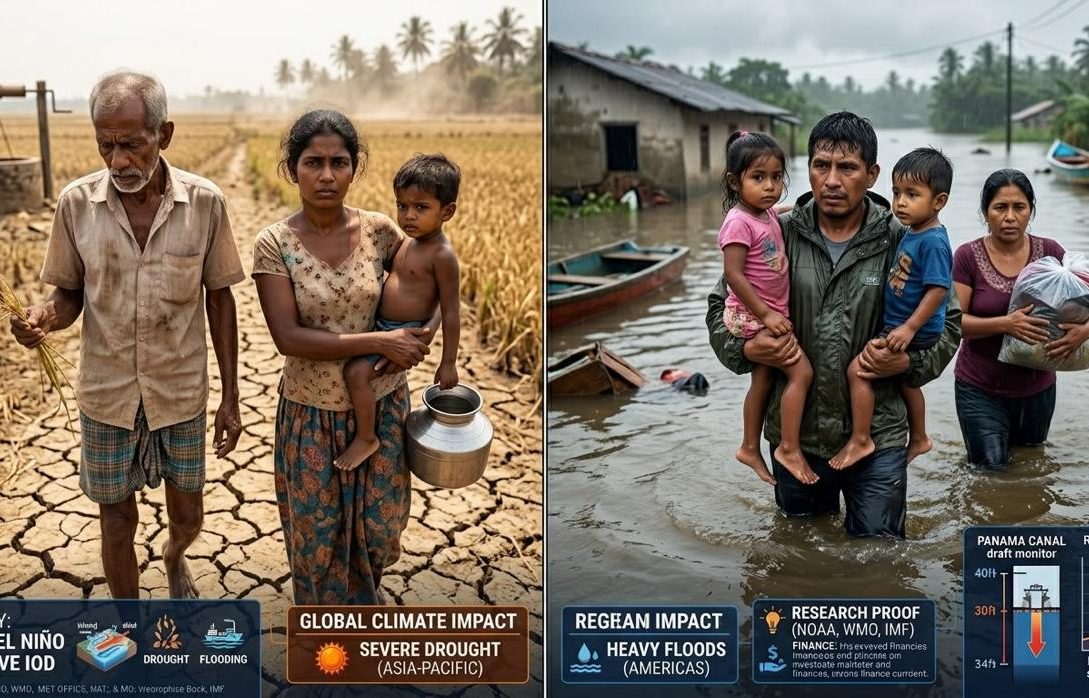
The speculative phase is officially over. The world’s leading meteorological authorities have confirmed the activation of a highly intense El Niño event. This is not merely a seasonal shift or a routine spike in regional temperatures; it is a systemic climate disruption poised to reshape global supply chains, volatile commodity markets, energy sectors, and the cost of living over the next 18 to 24 months.
According to the latest diagnostic briefs from the National Oceanic and Atmospheric Administration (NOAA) and the World Meteorological Organization (WMO), planetary climate engines are now fully locked into an El Niño phase.
- The Core Scientific Proof: Verifiable Data Points
To understand why international economists and climate scientists are sounding the alarm, we must look at the hard empirical data captured by oceanic sensors and satellite telemetry:
The Subsurface Heat Reservoir
Satellite data and deep-ocean buoys from NOAA’s Tropical Atmosphere Ocean (TAO) array have detected a massive subsurface heat anomaly in the equatorial Pacific. Water temperatures below the surface have registered up to 6^\circ\text{C} above the multi-decadal average. As this vast reservoir of thermal energy upwells to the surface, Sea Surface Temperature (SST) anomalies are breaking past the critical 2^\circ\text{C} threshold.
Historical Intensity Projections
The UK Met Office’s predictive modeling indicates that the current atmospheric-oceanic coupling points toward an intense event—potentially ranking as one of the most severe on record. Statistically, this trajectories 2026 and 2027 to have a 90% probability of eclipsing prior years to become the warmest period in recorded meteorological history since 1850.
Official Probability Thresholds
The WMO’s latest Global Seasonal Climate Update places the stabilization probability of this El Niño event at 80% through the mid-year quarter, surging to an undeniable 90% certainty as the world transitions into the final quarters of the year.
2.”The Twin Engines of Chaos”: El Niño and the Positive IOD
The true danger of the current climate landscape lies in a rare and volatile atmospheric synchronization. The Pacific El Niño is not acting alone; it is compounding with a highly active Positive Indian Ocean Dipole (IOD).
When these two oceanic phenomena align, they alter global wind and precipitation patterns through a dual-mechanism:
The Pacific Engine: Unusually strong low-level westerly wind anomalies across the Pacific basin push the warm pool of surface water eastward toward the Americas. This leaves the western Pacific and Asian marine borders significantly cooler, suppressing the convection cycles necessary for cloud formation.
The Indian Ocean Engine:
Simultaneously, the Positive IOD warms the western Indian Ocean near Africa while cooling the eastern waters near Sumatra and the subcontinent.
This dual-oceanic anomaly structurally blocks moisture transport across South and Southeast Asia, severely weakening seasonal monsoons and triggering prolonged, systemic droughts.
3.Global Regional Impact: A Divided Planet
As verified by international climate modeling networks, the macro-environmental impacts will bifurcate sharply across geographical boundaries, triggering entirely different crises depending on the hemisphere.
In South and Southeast Asia, encompassing nations like India, Sri Lanka, and Indonesia, the primary forecast is a severe monsoon deficit coupled with sustained heat stress. This directly triggers crop failures in vital sectors like rice and sugar, threatens to deplete local water tables, and creates hydro-power generation deficits.
Meanwhile, Australia faces an extreme moisture deficit and rapid vegetation drying. This brings a severe threat of widespread bushfires, threatens to collapse livestock feed operations, and is already forcing a sharp escalation in insurance reinsurance premiums across the continent.
In stark contrast, The Americas—particularly the Southern USA, Peru, and Brazil’s southern basin—will experience the exact opposite extreme. These regions are bracing for torrential atmospheric rivers, hyper-precipitation, and flash flooding. The resulting economic risks include severe infrastructure destruction, major logistics delays, and structural disruptions to open-pit mining operations.
4.Macroeconomic Consequences:
Inflation and Supply Chain Shocks
The World Economic Forum (WEF) and the International Monetary Fund (IMF) have highlighted that a strong El Niño event functions as a direct stagflationary shock to the global economy.
Commodity Price Volatility (The Food Crisis)
The geographical footprint of El Niño directly overlaps with key agricultural superpowers: Brazil (sugar and coffee), India (rice and wheat), and Indonesia (palm oil).
Structural supply shortfalls are projected to drive global food commodity indexes upward by 20% to 35% over the coming year, triggering a renewed wave of global food asset inflation.
Maritime Logistics Bottlenecks
Previous climate anomalies demonstrated how severe droughts can cripple key maritime chokepoints like the Panama Canal by lowering operational water levels and capping daily vessel transits.
The current intensity projections indicate a high probability of renewed draft restrictions, driving up global ocean freight rates and disrupting tightly wound maritime supply chains.
Industrial Energy Crises
A significant portion of developing economies rely heavily on hydroelectric infrastructure. As reservoirs deplete due to rainfall deficits, nations are forced to pivot rapidly toward expensive thermal power (coal and oil). This surge occurs precisely when regional grids experience peak demand due to domestic cooling, creating localized power grid failures and escalating commercial energy tariffs.
5.Regional Focus: The Phenomenon of “Climate Whiplash”
For regions positioned directly in the path of the Indian Ocean Dipole and El Niño—such as South Asia—the environmental impact will manifest as a highly volatile, two-phased cycle known as Climate Whiplash.
Phase I: The Monsoon Deficit (Mid-Year)
The initial phase is defined by a significant weakening of the Southwest Monsoon. Rainfall yields fall far below long-term averages. This triggers immediate drawdowns in national hydro-catchment areas, driving up air-conditioning demand amid climbing heat stress and threatening early-stage crop cycles.
Phase II: The Late-Year Flash Deluge (Q4)
Paradoxically, historical climate data proves that intense El Niño years frequently cause an atmospheric over-correction during the transition into the late-year Inter-Monsoonal and Northeast Monsoon periods. The atmosphere, superheated from the preceding dry months, holds more moisture. When triggering fronts arrive, it results in hyper-concentrated, torrential downpours over brief windows—causing catastrophic flash flooding, landslides, and sudden infrastructure failure.
6.Strategic Actionable Insights for Industry Leaders
Navigating an environmental disruption of this scale requires data-driven, preemptive corporate strategy rather than reactive
operational adjustments:
- Agribusiness & Procurement: Corporate supply chains must aggressively diversify raw agricultural sourcing. Relying on single-origin agreements within high-risk El Niño zones introduces severe operational vulnerability. Hedging strategies against commodity price volatility should be prioritized.
- Manufacturing & Global Apparel: Raw materials like natural cotton are highly sensitive to regional yield shocks in major producer nations (such as India and parts of the US). Sourcing teams must anticipate input cost fluctuations and factor material price variances into long-term financial forecasts.
- Energy Infrastructure Resilience: Organizations should execute rigorous energy audits and transition critical operations toward localized renewable backups (such as commercial solar infrastructure) to insulate production lines from municipal grid load-shedding and volatile industrial power costs.
Strategic Conclusion: The 2026 El Niño event is no longer an abstract ecological projection; it is an active variable in the global market. The organizations and economies that analyze the empirical data now and build structural resilience into their operations will survive the impending macroeconomic turbulence. Those relying on reactive operational models will find themselves highly exposed to one of the most significant climate-driven economic shocks of the decade.
Data compiled from the June 2026 Climate Diagnostic Updates issued by NOAA, the World Meteorological Organization (WMO), and global operational climate indices.